
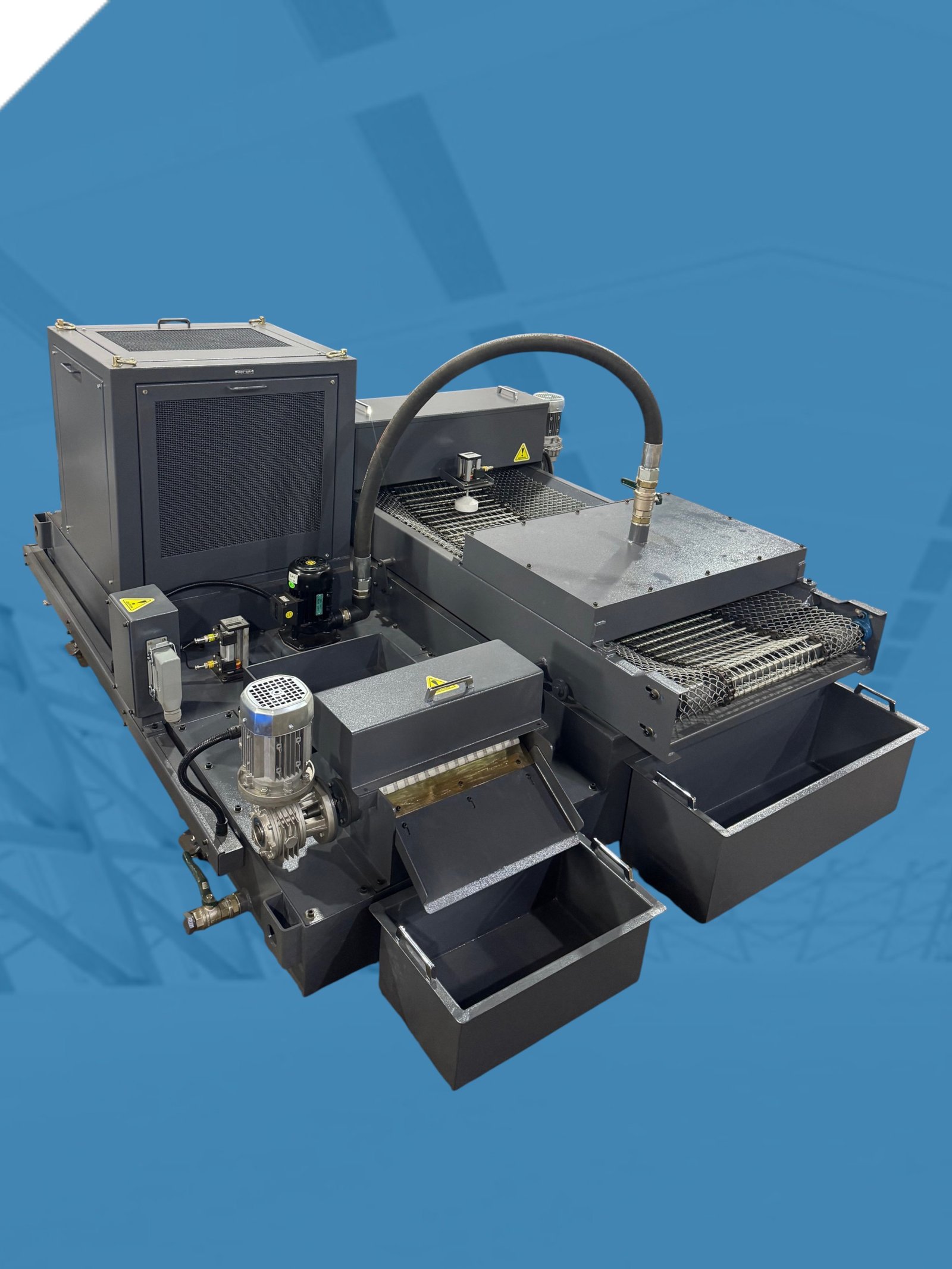
COOLANT FILTRATION SYSTEMS

Mag Tools coolant filtration system unit is fabricated in steel. This entire unit is fixed on a coolant tank with a pump to supply clean coolant back to the grinding machine. The filtering paper is spread over an endless stainless steel mesh conveyor which is connected to a geared motor. this uniquely designed conveyor prevents overflowing of the liquid and the full width of the filter paper is used in filtration of the coolant. The movement of the filter paper is controlled by a float switch which activates the geared motor to move forward.

Coolant filters for grinding machines are crucial components in maintaining the efficiency and longevity of the equipment. They ensure that the coolant used in the grinding process remains clean and free from contaminants, which can otherwise affect the quality of the finished product and the performance of the machine.

Coolant Filtration System — How It Works, Benefits, Applications, and Buying Guide


Keep your CNC machines, grinders, and production lines running cleaner and longer with a reliable coolant filtration system. By continuously removing chips, fines, and tramp oil, a well‑designed system improves surface finish, extends tool life, and reduces operating costs across your shop or central coolant plant.

What Is a Coolant Filtration System?

A coolant filtration system cleans cutting fluids, emulsions, synthetics, or straight oils by removing solid particles (ferrous and non‑ferrous) and separating tramp oil. Systems can be standalone for a single machine or centralized to serve multiple machines.

How It Works

  • Intake: Contaminated coolant returns from the machine to the filter tank.
  • Primary separation: Magnetic drums/bars capture ferrous fines; chip conveyors remove large swarf.
  • Fine filtration: Paper‑bed filters, bag/cartridge filters, or hydrocyclones remove small particles.
  • Tramp oil control: Skimmers, coalescers, or centrifuges separate free oils.
  • Conditioning: Chillers/heat exchangers stabilize temperature; dosing maintains concentration and pH.
  • Clean return: Clarified, conditioned coolant is pumped back to the machine.

Key Benefits

  • Longer coolant life: Removes solids and oils that degrade emulsions, cutting chemical consumption.
  • Better surface finish: Prevents abrasive recirculation; improves Ra and dimensional stability.
  • Increased tool life: Reduces edge wear, chipping, and built‑up edge on inserts and wheels.
  • Lower maintenance: Fewer sump cleanouts, fewer filter changes, and less downtime.
  • Health and safety: Cleaner coolant lowers mist particulates and odor; easier compliance.
  • Lower total cost: Less media use, reduced disposal volumes, more uptime, and energy savings from clean heat exchangers.
  • Sustainability: Recycle captured metals; reduce waste coolant and single‑use media.

Applications

  • Grinding: Surface, cylindrical, centerless, creep‑feed.
  • CNC machining: Turning, milling, drilling, tapping, broaching.
  • Gear manufacturing: Hobbing, shaping, grinding.
  • Cast iron, steel, and hard‑metal processing.
  • Central coolant systems for automotive, bearings, and general engineering.
  • Quench and parts‑washing loops (oil and aqueous).

Filtration Technologies You Can Combine

  • Magnetic coolant separators/drums for ferrous fines.
  • Paper‑bed gravity filters for high throughput polishing.
  • Bag/cartridge filters for targeted micron ratings (20–5 µm).
  • Hydrocyclones for non‑ferrous fines without consumables.
  • Centrifuges for ultra‑fine solids and emulsified tramp oil.
  • Coalescers, skimmers, and vacuum belt skimmers for free oil.
  • Chip conveyors and settling tanks for bulk swarf.

How to Select the Right System

  • Flow rate: Peak return flow (L/min) with 20–30% headroom.
  • Particle load/size: Grinding haze vs mixed chips; set micron targets and stages.
  • Material mix: Ferrous vs aluminium/brass dictates magnetic vs cyclonic/media balance.
  • Coolant type: Emulsion, synthetic, or straight oil affects viscosity and dwell time.
  • Temperature control: Need for chillers/heat exchangers to stabilize processes.
  • Footprint and layout: Sump space, machine interface heights, maintenance access.
  • Automation: Level control, differential monitoring, auto paper advance, PLC integration.
  • OPEX preferences: Minimize consumables vs maximize polish; plan for sludge handling and recycling.

Installation Best Practices

  • Stage filters: Magnet first, then cyclonic/media, then polishing as needed.
  • Ensure even distribution across filter width; avoid bypass paths.
  • Set correct weir heights and dwell time for consistent clarity.
  • Provide drain‑back on sludge bins to recover coolant.
  • Plan service access for wipers, media rolls, pumps, and sensors.
  • Integrate tramp oil removal to protect chemistry and reduce odor.

Maintenance Tips

  • Track differential level/pressure to spot overloads or blinded media.
  • Inspect wipers, seals, and pump strainers on a fixed schedule.
  • Verify concentration and pH; adjust dosing based on make‑up water quality.
  • Clean heat exchangers and verify chiller setpoints for thermal stability.

Why Choose Our Coolant Filtration Systems

  • Engineered for Indian manufacturing: Robust builds, corrosion‑resistant materials, and high‑energy magnets.
  • Modular, scalable designs: From single‑machine skids to central plants with multiple stages.
  • Quick ROI: Savings from longer tool life, fewer media changes, and reduced downtime.
  • End‑to‑end support: Sizing, installation, commissioning, AMCs, and spares with fast response.

FAQs

  • What micron rating do I need?
    Ans : For grinding, target 10–20 µm after magnetic stage; for precision finishing, add 5–10 µm polishing.
  • Will it work with aluminium?
    Ans : Yes—use hydrocyclones or media filters for non‑ferrous fines; magnets handle ferrous only.
  • Can I retrofit to one CNC?
    Ans :  Yes—compact skids combine magnet + bag filter + skimmer for small footprints.
  • How fast is payback?
    Ans :  Many shops see payback in months from tool, coolant, and downtime savings.

1.(MODEL PBF- PBMF)

2. DIMENSIONAL DETAILS OF SLOTTED TYPE MAGNETIC COOLANT FILTER

PAPER BAND COOLANT FILTRATION SYSTEM WITH 3 TON DIP IN CHILLER FOR GRINDING MACHINES

Contact

Interested in learning more or need a custom solution?

Mag Tools

B-465, Industrial Estate 2nd Gate, Gokul Road, Hubli, 580030 (Karnataka )

Phone Number

Phone: +91-836-2335990
Fax : +91-836-2332297
Cell : +91-93434-03619
Cell 2 :+91-9880-666722

Email Address

Mr. A.T. Pawar: atpawar@magtoolsindia.com
Mr.Tushar Pawar: tushar@magtoolsindia.com

Get in Touch